Textualism in Rule Interpretation
Robustness of Textualism as a Focal Point
Introduction
If you ask one person to suggest a date, they may choose one of personal significance, such as their mother’s birthday. However, if you ask two strangers to coordinate, they may choose a date that is significant to both of them, such as the current date or a date that marks a special occasion. Successful coordination often depends on the existence of a focal point (Schelling, 1960) (Sugden & Zamarrón, 2006).
In a legal context, previous research has found that coordination incentives drive people to choose a textualist interpretation of a rule (Bystranowski et al., 2025), rather than considering the purpose of the rule (potentially because the purpose is less publicly accessible, or more susceptible to idiosyncratic interpretations among those subject to the rule).
However, evidence for a textualist focal point has only been found in studies involving participants from the United States, and focal points can vary across contexts—particularly depending on how much coordinators know about each other’s knowledge (De Freitas et al., 2019).
Furthermore, this effect has only been demonstrated at the aggregate level. Consequently, it is unclear whether baseline differences in people’s interpretative preferences increase or decrease textualism under coordination incentives. For instance, empathy has been found to be negatively correlated with textualist interpretation (de Almeida et al., 2025), potentially because empathy fosters consideration of the rule’s underlying purpose.
Our research
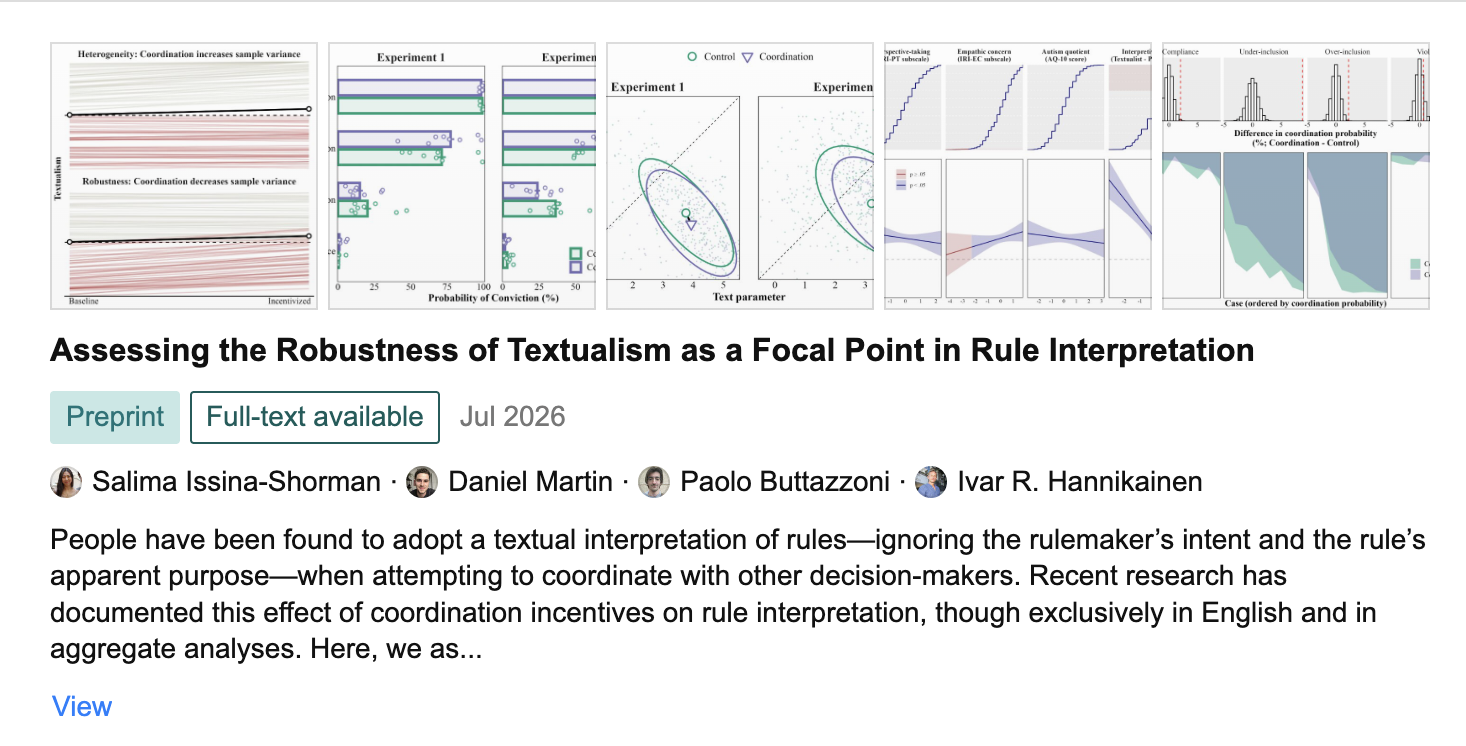
In the present study, we investigate whether coordination increases the average emphasis placed on text over purpose and whether it reduces variability among individual interpreters. To address these aims, we model the impact of coordination on rule interpretation at an individual level. In two experiments, we estimate the extent to which individuals rely on the text and the purpose of rules, and we apply location-scale modelling to assess whether incentives for coordination increase or reduce variance in these components of rule interpretation. We also investigate whether coordination goals foster textualism, regardless of individual differences in empathy and autistic traits, by using validated psychometric assessments. Based on previous research (e.g. (Baron-Cohen et al., 2001)), we hypothesise that individual differences in autism may be correlated with textualism to the extent that deficits in theory of mind preclude consideration of the rulemaker’s intent or the rule’s effective purpose.
Some preliminary results 
In two experiments, we demonstrated that incentives for coordination reduced participants’ consideration of the purpose of the rules when making judgements about transgressions, thereby strengthening the tendency towards textualism. This finding is consistent with previous research (Hannikainen et al., 2022) investigating the impact of coordination incentives on textualist interpretation. This was observed in both a Spanish-speaking global sample (Exp1) and a Spanish national sample (Exp2). This interpretation aligns with theoretical accounts in which the text of a rule is said to provide a focal point for coordinating multiple interpreters’ verdicts (Schelling, 1960).

Furthermore, we examined whether the effect of coordination remains consistent despite differences in interpretive preference and its associated factors, such as empathy, perspective-taking, and autism. Empathy and autism are associated with different interpretive approaches: empathy is linked to a greater reliance on the spirit of the rule, i.e. its purpose (Almeida et al., 2025), whereas autistic traits are associated with deficits in both textual and purposive interpretation. Nevertheless, coordination incentives increased adherence to the text across most levels of perspective-taking, empathy, and autistic traits.
Overall, these findings provide the first replication of the effect of coordination on rule interpretation in a non-English-speaking sample. The robustness of textualism as a focal point can only be fully assessed by considering individual differences in baseline interpretive preferences.
This work has already been submitted; you can find the preprint on ResearchGate:
References
2025
- Legal Interpretation as CoordinationIn The Cambridge Handbook of Experimental Jurisprudence, 2025
- Trait Empathy Predicts a Preference for the Spirit of the Law: Nationally Representative Survey Evidence2025
2022
2019
- Common Knowledge, Coordination, and Strategic Mentalizing in Human Social Life2019
2006
- Finding the Key: The Riddle of Focal Points2006
2001
- The Autism-Spectrum Quotient (AQ): Evidence from Asperger Syndrome/High-Functioning Autism, Males and Females, Scientists and Mathematicians2001
1960
- The Strategy of Conflict1960